Coffee at the Office: The Boost That Hides Your Fatigue
Posted on July 22, 2026 • 8 min read • 1,589 wordsAt the office, coffees pile up: ritual, break, a boost before a meeting. What if that boost mostly masks a background fatigue? A small investigation, from observed behavior to what the science says.
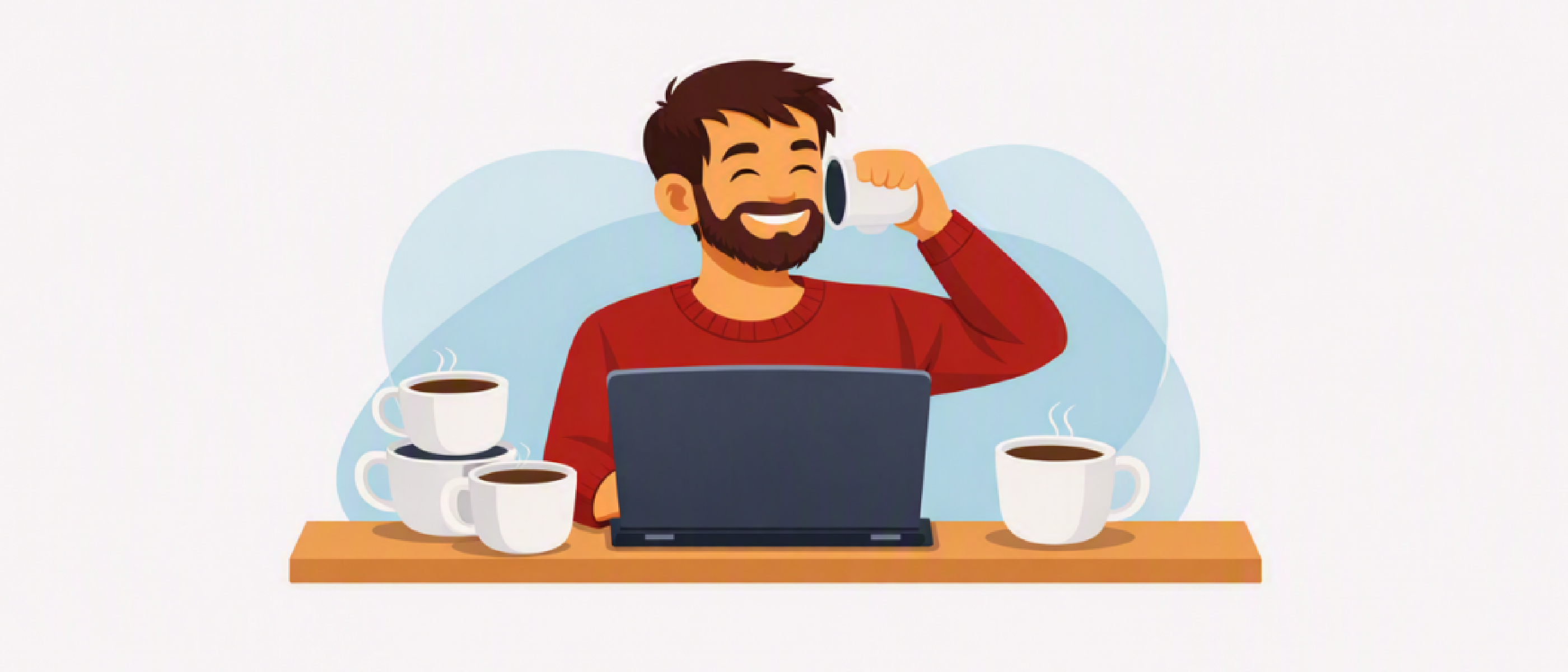
Look around you on an ordinary day at the office. The first morning coffee, the 10 a.m. break one, the last little cup before the big meeting. Many people drink several a day, take real pleasure in it, and would swear they need it to keep going. Nothing alarming there. But one observation is intriguing: why, when they skip their coffee, does a sudden — sometimes fierce — fatigue set in? This article starts from that everyday behavior and descends, layer by layer, toward what the science says.
I. A puzzling observation
Coffee, at work, plays several roles at once: it’s a ritual (the machine, the break, the social bond), a pick-me-up in the morning, and a boost before a demanding moment — a presentation, a heavy workload, a need to focus.
All of this clearly works. But something doesn’t add up. If caffeine merely added energy, going without it for a day should simply return us to a neutral state. Yet that’s not what we observe: in the regular consumer, stopping often triggers headaches, difficulty concentrating, and deep fatigue. As if coffee didn’t give energy, but hid a deficit. That’s the lead this investigation will follow.
II. First layer: how caffeine works
To understand, you have to look at what happens in the brain — and a popular-science video by Kurzgesagt – In a Nutshell, which this article is based on, sums it up very well.
While you’re awake, a molecule called adenosine builds up in the brain and binds to its receptors. The more it accumulates, the more it signals: it’s time to slow down, to sleep. It’s one of the mechanisms of fatigue.
Caffeine has a shape very close to that of adenosine. It therefore slips onto the same receptors and blocks them, preventing adenosine from delivering its message. A review in the British Journal of Pharmacology (Jacobson et al., 2022) specifies that it acts as a non-selective antagonist of the A1 and A2A receptors, with similar affinity for both — which explains its effects at everyday doses. So you stay alert not because energy was added, but because the fatigue signal was cut; in parallel, caffeine promotes the release of neurotransmitters that improve mood and attention.
III. Second layer: why the body gets used to it
Here’s the crux of the matter. The brain doesn’t like having its receptors blocked for long: it adapts. With daily caffeine, it produces more adenosine receptors to compensate — a tolerance mechanism documented long ago (Fredholm, Role of adenosine receptors in caffeine tolerance, 1991). The consequence: you need more and more coffee for the same effect.
And above all, adenosine keeps accumulating behind the caffeine that masks its action. As soon as the coffee’s effect wears off, that whole stock floods onto now-more-numerous receptors all at once: this is the rebound, the amplified fatigue felt by anyone who skips a dose. The morning coffee then largely just repairs the deficit built up overnight.
This deficit has a name — withdrawal — and it’s real, but reassuring. The reference review on the subject (Juliano & Griffiths, Psychopharmacology, 2004) reports that symptoms appear 12 to 24 h after stopping, peak around 20–51 h, and generally last 2 to 9 days. In other words: unpleasant, but transient.
IV. Third layer: is the “boost” really a gain?
Now comes the uncomfortable question. If the morning coffee only fills a deficit, then the famous “boost” may not be a net gain, but simply a return to normal.
This is the withdrawal reversal hypothesis, championed notably by researcher Peter Rogers (Caffeine and Alertness: In Defense of Withdrawal Reversal, 2014). In the regular consumer deprived of coffee, caffeine restores alertness… without pushing it beyond that of a person who doesn’t consume any. The habitual drinker, off caffeine, starts from a lowered level; coffee simply brings them back to everyone else’s starting point. A tellingly titled study — Faster but not smarter (Psychopharmacology, 2013) — points the same way: caffeine speeds you up, but doesn’t add intelligence.
Honesty is required, though: the debate is not settled. Other work shows real benefits, especially in non-consumers or in cases of sleep deprivation, where caffeine markedly improves alertness and performance (synthesis in Effects of Caffeine on Cognitive Performance, Mood, and Alertness in Sleep-Deprived Humans, NCBI). The truth probably lies somewhere in between — which is why it’s worth not confusing an occasional tool with a daily dependence.
V. Making peace with your coffee: finding the balance
None of this says you should quit coffee — only that it’s better to steer it than to be steered by it. What the literature draws out, notably Astrid Nehlig’s review (Neuroscience & Biobehavioral Reviews, 2016):
- Stay in the useful dose range. Benefits on attention and reaction time appear at low to moderate doses; beyond that (~400 mg, roughly four cups), you mostly gain anxiety and degraded sleep, and performance can even worsen — the well-known inverted-U curve, also described in the work compiled by the NCBI (Doses and Delivery Mechanisms).
- Watch the timing. Caffeine has a long half-life (on the order of five to six hours): a 5 p.m. coffee is still active at bedtime. Moving your last cup to early afternoon protects your sleep — and therefore the next day’s energy.
- Break the tolerance. “Off” days, or lighter ones, keep the dose from creeping up indefinitely.
The irony is worth underlining: past a certain point, drinking more coffee to fight a fatigue caused by coffee itself only feeds the cycle described above.
VI. Decaf: keep the ritual, keep (some of) the benefits
For those who love the gesture more than the molecule, decaf is a serious option — and not an empty substitute. “Decaffeinated” means about 97% less caffeine (often 2 to 5 mg per cup versus 80 to 100 mg), but the bean retains most of its other bioactive compounds. Two families are worth pausing on.
Polyphenols are a large family of plant-derived molecules, known for their antioxidant action: they help neutralize oxidative stress, the process involved in cell aging and several chronic diseases. Coffee is one of the main sources of them in the Western diet — not because it’s the richest, but because we drink a lot of it.
Among them, chlorogenic acids are the dominant polyphenols in coffee, and therefore its main “health” compound. Research credits them with a role in blood-sugar regulation (they slow the absorption of sugars) and a vasorelaxant effect on vessel walls, via pathways such as endothelial nitric oxide (eNOS) — a mechanism described in reviews on coffee and cardiovascular health (Nutrients, 2024). Crucially for our topic: these molecules are not caffeine, and decaffeination leaves them largely intact.
That’s why decaf isn’t “empty coffee.” A direct caffeinated/decaffeinated comparison (ScienceDirect, 2024) even observes that chronic decaf intake also improves certain metabolic markers (blood glucose, liver function). So what science credits to decaf: it keeps the polyphenols associated with these favorable effects, it preserves the ritual without restarting the tolerance/rebound cycle, and it allows an evening coffee without sacrificing sleep.
One technical point remains debated, though: the solvent methylene chloride, used by some decaffeination processes. As a Chemical & Engineering News feature (ACS, 2024) explains, residues in the final cup are minute and barely survive roasting; for anyone who prefers to avoid the question, the “solvent-free” processes (Swiss Water, supercritical CO₂) are clear reference points.
VII. The honest answer: there’s no single rule
One last, essential point: everything above describes tendencies, not a prescription. Caffeine is akin to a mild medication, and as with a medication, the right dose depends on the person. How fast you metabolize it, your sensitivity to anxiety, the quality of your sleep, your age, pregnancy: all of these mean the same cup doesn’t have the same effect on two desk neighbors.
So there isn’t one right way to go about it. Cutting doses, shifting the timing, alternating with decaf, or changing nothing because all is well: these are options, to be tuned to yourself. The point isn’t to follow a rule, but to know what’s at play in the cup — so you can choose knowingly rather than on autopilot.
This article is not medical advice. In case of sleep problems, anxiety, palpitations, or doubt, the right place to turn is a healthcare professional.
Conclusion
Coffee on repeat at the office is nothing to be ashamed of — it’s a pleasure, a ritual, sometimes a genuine helping hand. But the investigation reveals a quiet mechanism: much of its “boost” consists of repairing the fatigue it itself helped to mask. Understanding this doesn’t spoil the pleasure; it lets you take back control.
The takeaway: caffeine doesn’t create energy, it borrows time from your fatigue. Well dosed, well placed in the day, possibly relayed by a decaf for the ritual, it remains a good ally. It’s then up to each person to find their balance — because here, as in medicine, the right answer is the one that works for you.
Useful links
Kurzgesagt – In a Nutshell (video on caffeine)
The animated explainer this article is based on.Jacobson et al., British Journal of Pharmacology (2022)
The mechanism of caffeine’s action on the adenosine A1 and A2A receptors.Juliano & Griffiths — A critical review of caffeine withdrawal (2004)
Symptoms, intensity, and duration of withdrawal.Rogers — In Defense of Withdrawal Reversal (2014)
The case for the “withdrawal reversal” hypothesis.Coffee and Cardiovascular Health, Nutrients (2024)
The bioactive compounds retained, including in decaf.